




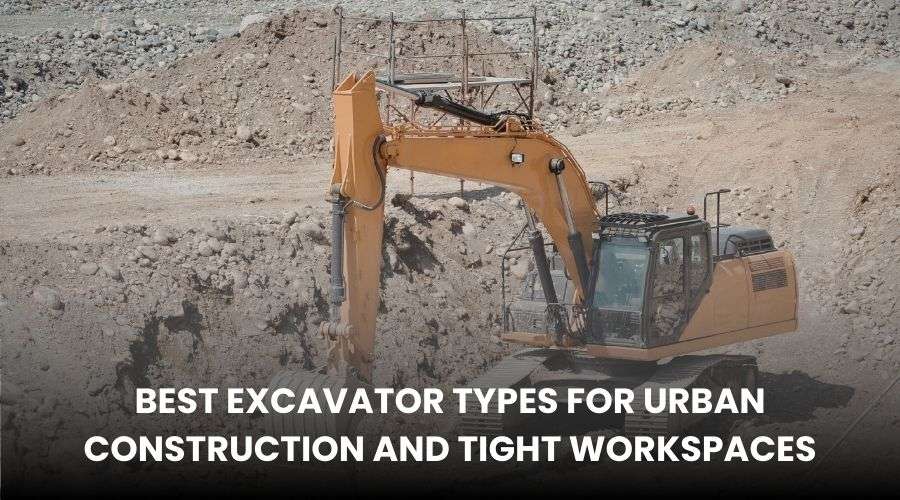
City excavation projects often occur in congested areas. The access points, like a narrow gate, alley, or staging area, are constricted and quite small for an excavator to pass through. Then there are overhead obstacles like balconies, scaffolding, and power lines, plus underground congestion such as gas, telecom, and storm lines. All this means the excavator may get stuck or be unable to maneuver properly, slowing the project. In this environment, “best excavator” usually means the machine that fits and works safely with the fewest repositioning moves, not the biggest machine you can get delivered.
If you are wondering which excavator types can streamline a city construction project, you have come to the right place. In this blog, we will explore in-depth the most useful excavator types for urban construction and tight spaces, how they differ, and how to choose between them without getting trapped by common quoting mistakes.
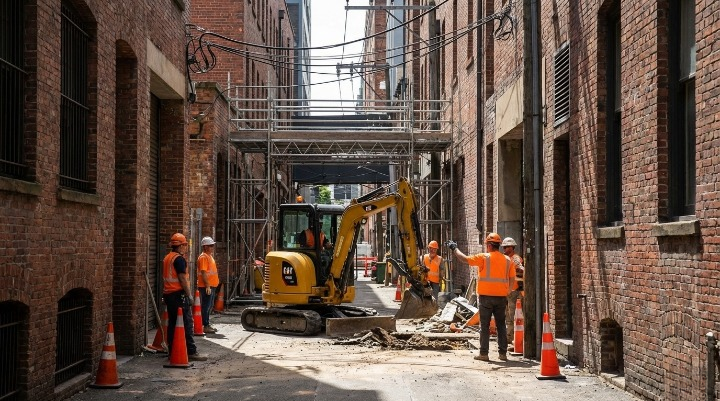
Start by considering the ease of access and reach for the excavator, since that matters more than digging power in tight spaces. Measure the narrowest point the machine must pass through. Most often, they are gates, driveway turns, and interior doors if the job is to be done indoors. Another factor to consider is the excavator’s approach angle. A machine might fit through a gate but still be unable to turn once inside. If you skip this step, you can end up paying for standby time while the crew “makes it work,” or you rebook transport and lose days.
Next, focus on swing clearance. In urban sites, the machine’s rear often matters as much as the front. If the excavator tail can swing into a fence, a wall, a parked car, or live traffic, then you will need extra spotters, extra barriers, and a larger exclusion zone. That slows work and increases exposure. Choosing a machine with less tail swing can reduce these complications, but it may come with trade-offs you should understand before you commit.
Ground conditions are another source of delays. Urban ground usually consists of a variety of surfaces like pavement, pavers, landscaping, basement slabs, and soft subgrade. Each surface behaves differently to the excavator's weight and tracks. A heavier excavator may increase productivity in open sites, but in tight urban areas, this advantage will become a drawback. The extra weight can crack surfaces and leave ruts. And if that occurs, you will have to pay for restoration that will drain your budget.
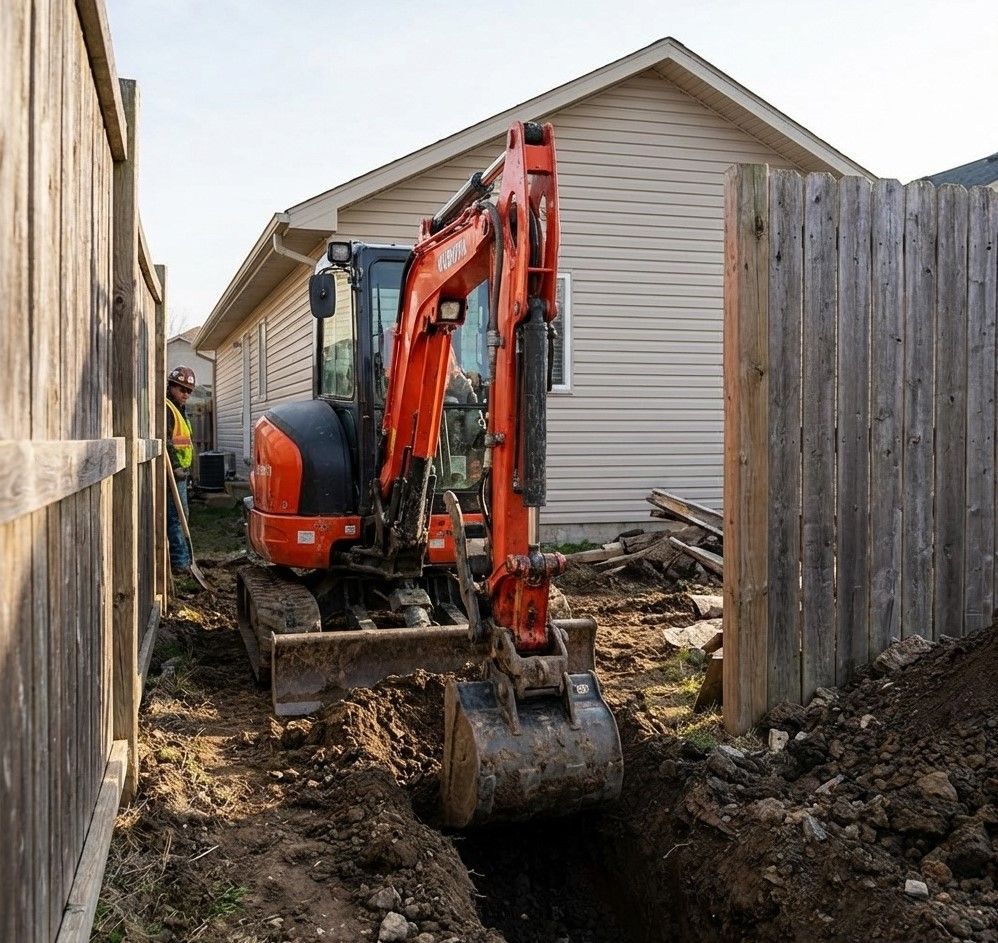
Mini excavators are often the safest choice in tight urban work because they combine a small footprint with practical capability. If you are trenching for utilities, doing small foundation work, or excavating in backyards and courtyards, a mini excavator can usually access the site, operate with less disruption, and load spoils efficiently.
The main advantage of a mini excavator is maneuverability. You can work in narrow corridors, rotate within small staging areas, and reduce the amount of traffic control you need compared with larger machines. Minis also tend to be easier to transport, which helps when you have multiple small jobs and limited time windows.
Sourcing the Right Fit: Since urban jobs demand precise sizing, working with a trusted mini excavator exporter makes it easier to match machine specs, attachments, and delivery timelines to tight-space project requirements.
Zero tail swing machines are built to keep the rear of the upper structure within the track width during rotation. In practical terms, this reduces the chance that your counterweight swings into a wall, fence, or traffic lane. On crowded sites, that can be the difference between smooth production and constant stop-start repositioning.
ZTS is most valuable when you must work close to fixed obstacles and cannot afford a large swing radius. It can also reduce the size of the exclusion zone behind the machine.
Reduced tail swing excavators offer a middle ground. The rear swing is smaller than a conventional machine but not fully contained like ZTS. For many urban jobs, RTS can provide a good balance between compact swing clearance and stability.
To make the correct choice, first verify your actual clearance needs. If you truly have no space behind you, RTS may not be enough. If you do have some clearance, RTS can be a practical choice.
Sometimes the site is small and constricted, but the work is heavy and intensive. In those cases, a short-radius or compact excavator can deliver the necessary power while keeping the swing radius tighter than a standard machine. Compact radius larger excavators are the perfect fit for tasks involving deeper excavations, larger basements, or heavier demolition tasks where a small excavator would be slow and may not handle the required attachments.
The main advantage is increased power, reach, and lifting capacity, and a higher loading capacity. And that performance can be executed within a compact swing area. However, there is a trade-off as well. Larger machines weigh more and can cause cracks in the pavement. They also need more permits and subgrade, and may require more complex transport and permits. If you choose this option, you should confirm ground protection requirements and the available space for trucks and spoils.
Wheeled excavators excel in urban locations that have paved surfaces, and the excavator needs to change its position a lot. If your job involves moving along streets or between nearby work zones, wheeled excavators will cover the distances faster than tracked excavators.
This type of excavator is well-suited to road and sidewalk utility work, especially when paired with outriggers or a blade for stability during digging. It also helps reduce surface damage in some conditions, though tire wear and traction limits can be factors depending on debris, slopes, and wet ground.
Choosing the best excavator for urban construction and tight workspaces comes down to broadly three factors: fit, swing clearance, and predictable performance. Mini excavators are often the most practical starting point because they access more sites and reduce disruption.
Zero tail swing and reduced tail swing designs help you work closer to obstacles and traffic with fewer compromises to the work zone. Short-radius larger excavators make sense when volume and depth demand higher production, but they require careful attention to surface impact and logistics.
Wheeled excavators can save time on paved, multi-stop urban work when stability and ground conditions are suitable. Hybrid compact excavators can reduce noise and emissions challenges when charging and runtime are planned.
Picking between mini, ZTS, RTS, short-radius, and wheeled excavators depends heavily on your specific site constraints, and having access to the right range of machines makes that decision much easier.
JG Excavators Factory supplies a full lineup of crawler, wheeled, and mini excavators suited to congested urban sites. Reach out to our team to find the right machine for your next project.
A crawler excavator depends entirely on its tracks for movement, st
READ FULLWheeled excavators represent a critical evolution in heavy machiner
READ FULLCrawler excavators stand as the most common heavy digging machines
READ FULL