




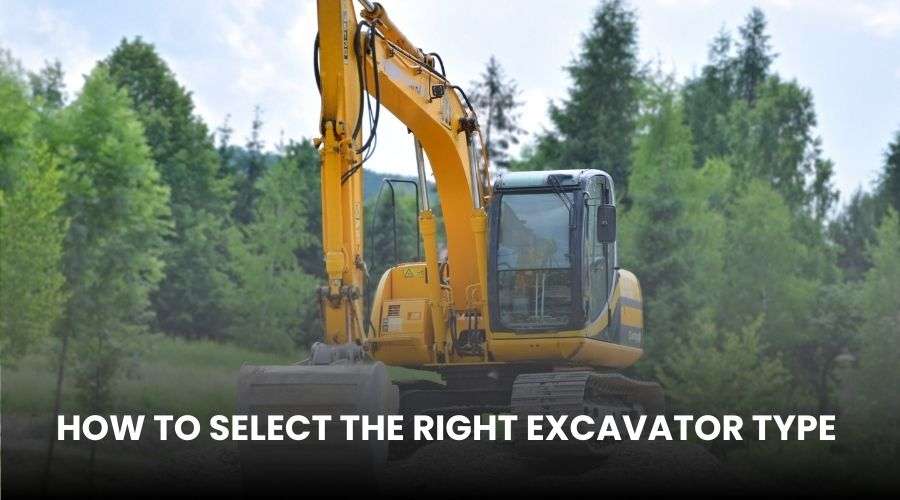
Excavator selection is not a preference. It is a production decision that either protects your schedule or quietly bleeds it. The right machine keeps cycle times tight, keeps the trench clean, and keeps trucks moving without idle gaps. The wrong machine drags. It wallows. It forces extra handling.
Undersized excavator tempts operators to overreach and overwork. And an oversized one chews grade, bruises finished surfaces, and burns fuel for no gain. Mobilization can also punish you; permits, hauling, and site access become the real job.
Start by calling the work what it is. Trenching is not mass excavation. Utility work is not demolition. If you pick a machine to handle “everything,” it will do nothing well.
Every excavation project has essential requirements. In most cases, they are the dig depth, reach, and dump height. Your job is to define them clearly. A machine that cannot fulfil these exactly only wastes time or delays a project, as time is required for repositioning. Then define the material you expect to dig. This can range from clay that sticks, sand that sloughs, or rock that punishes teeth and jams buckets of the excavator.
Truck count and haul distance matter a lot for smooth project execution. An excavator that outpaces your truck's capacity by digging more creates chaos. On the other hand, a machine that can’t fill them adequately creates waiting lines, which slows down the operations.
Terrain in the project context means load capacity. Soft ground, wet muck, loose fill, these onsite conditions will destroy productivity and confidence if the project team brings the wrong undercarriage that does not grip the ground. You don’t want “good enough” traction. You want a predictable footing.
Side-hill work has a higher chance of accidents because swinging downhill with a high load drastically increases toppling risk for an excavator. One small misjudgment is enough for everything to go wrong.
Mini excavators have the winning edge when access to the digging site is tight, and damage is unacceptable. Their small size allows them to slip into backyards, between structures, and along live utilities. But they will not save you on production-heavy cuts.
Midi excavators (compact)
Midi bridges the gap. They give you real capability without the transport and footprint of larger crawlers. Compacts are strong in a variety of project scopes: trench, set boxes, clean up, and small loading. But apply them to bulk excavation, and they start to feel slow.
Crawlers are the backbone of general excavation and are the most frequently used in the construction industry. They are stable, productive, and reliable. Crawler excavators load trucks, cut slopes, and dig foundations without needing the ground to be perfectly smooth.
Wheeled excavators perform seamlessly where moves are frequent, and surfaces must stay intact. Roadwork and urban corridors are the projects with the best fit for them. But they struggle on soft ground.
Long-reach excavators
Long-reach machines are built for solving access problems by reaching from firm ground into unstable areas. They reduce accidental risk. But there are trade-offs like less power and a smaller bucket size for reach, and that trade means bulk loading is not possible.
High-reach demolition excavators
High-reach demolition is specialized for a reason. It brings controlled reach and safer standoff distance. It also brings setup needs and stricter planning.
Specialized variants
Zero-tail swing and reduced-radius excavators are special-purpose models that deliver clearance where space is scarce. But operating them requires skill in terms of sharper positioning and awareness.
Tracks spread load and hold stability on uneven terrain. Tires move fast, and reposition the excavator quickly. Neither is “better.” One is appropriate. The other is expensive.
Wide shoes and low-ground-pressure setups prove advantageous on soft ground. They reduce rutting and keep the excavator from sinking into the day. But flotation can reduce bite in some materials. It’s a balance, and the choice must be planned carefully.
Slope work, long reaches, and lifting demands are stability problems first. The undercarriage choice can either smooth the operation or roughen it up. A machine that feels planted keeps operators disciplined. A machine that feels sketchy forces operators to attempt risky moves.
Pick the excavator size based on the hardest lift, the longest reach, or the tightest dump height; whichever is more effective according to the nature of the project.
A bigger bucket does not always mean faster production. If it slows arm swing, or overloads the machine, or spills happen often, then the large bucket becomes useless. The goal is smooth cycles and clean cuts that are fast and controlled.
If you’re setting structures, pipe, boxes, or precast, treat lift charts as real constraints. Your planning should be done considering radius, ground conditions, and attachment weight. If lift calculations are off by a little, disaster can happen.
Many projects are not excavator jobs. Attachments play a crucial role and can make or break a project. Breakers, thumbs, grapples, compactors, augers, tilt buckets; these tools change the machine requirement. Ignore that, and you’ll rent a second machine under pressure.
Keeping a precise measure of hydraulic metrics is crucial for maximizing excavator uptime. Confirm auxiliary flow and pressure, line routing, case drain needs, and coupler compatibility. A tool that runs weak, overheats, or starves for flow will punish the schedule.
Couplers, buckets, and tools should swap cleanly across machines where possible, and that means the sizing of these attachments should be uniform. That consistency reduces downtime and operator workarounds. Workarounds are where mistakes live. Quietly.
|
Scenario |
Best-fit excavator type |
Undercarriage/setup |
Excavator Attachment details |
Risks |
|
Soft ground / wet site |
Tracked crawler, LGP option; long-reach from firm pad when needed |
Wide shoes or LGP; build a working pad early |
Consider a grading bucket for pad maintenance |
Getting stuck, pad collapse near edges, and rutting that ruins access |
|
Urban tight site |
Mini or midi; zero-tail or reduced-radius |
Rubber tracks or pads; strict swing clearance plan |
Thumb/tilt bucket for control |
Blind spots, swing strikes, surface damage claims |
|
Roadway work with frequent relocations |
Wheeled excavator |
Outriggers/blade discipline; road-safe moves |
Tilt bucket speeds finish work |
Reduced stability on soft shoulders; traffic interface risk |
|
Rocky excavation |
Standard crawler sized for breakout force |
Durable shoes; protect undercarriage |
Breaker, ripper tooth, rock bucket |
Wear costs spike; vibration impacts nearby structures |
|
Steep slopes/ditch lines |
Stable crawler; consider long-reach for reach-from-safe-ground |
Positioning plan: avoid a downhill swing with high loads |
Grading bucket; tilt where appropriate |
Slide risk, edge failure, operator fatigue |
|
Demo-heavy scope |
High-reach demo unit or protected standard crawler |
Guarding packages; clear exclusion zones |
Shears, grapples, breaker as required |
Falling debris, underestimated setup time, and dust control constraints |
The right excavator is the machine that matches scope, terrain, attachments, and logistics at the same time. Not in isolation. Together. When one is ignored, the job pushes back.
Selection is not a one-time decision made in the trailer. Scope shifts. Ground turns. Access tightens. A machine that was perfect on Monday can become a liability by Thursday. That’s not failure. That’s reality.
Make the decision with intent, document the constraints, and align the crew. Your job is to remove uncertainty before it becomes a delay. Choose an iron that stabilizes the operation. And keep it stable.
A crawler excavator depends entirely on its tracks for movement, st
READ FULLWheeled excavators represent a critical evolution in heavy machiner
READ FULLCrawler excavators stand as the most common heavy digging machines
READ FULL