




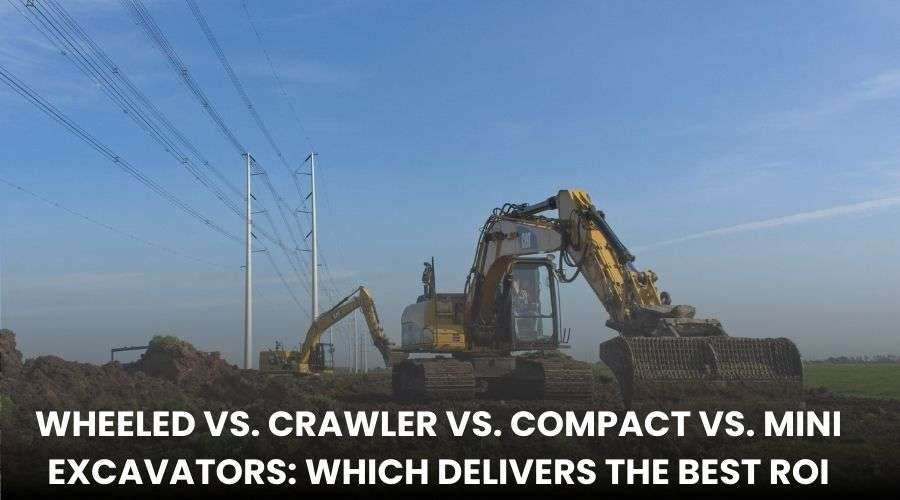
When you are selecting an excavator based solely on purchase price and large machine size, the "best ROI" on an excavator will be determined by selecting the type of machine that will allow your crew to work with the least amount of delay. This means that as a project manager, you have to take into account how quickly you can mobilize the excavator, what types of ground conditions may have an effect on how quickly the crew can begin to use the excavator, and what types of changes may occur during the project that could require you to obtain additional quotes and reschedule the project.
Most of the time, there are four different categories of excavators: wheeled, tracked, compact, and mini; but for the purpose of making a decision for excavator type, there are really only three categories: wheeled, tracked, or compact (including mini).
For most projects, excavator ROI is the combined impact of productivity, predictability, and logistics. Purchase price matters if you are buying to own. But even if you rent, the same cost drivers show up as higher rental class, longer duration, more trucking, or downtime.
A simple way to think about it is:
| ROI Factor | What It Means |
|---|---|
| Productive Hours | Total time the excavator is actively working |
| Output per Hour | Amount of work completed per hour |
| Time Lost | Delays from relocation, setup, recovery, or downtime |
Your biggest ROI losses all come from three avoidable problems:
✅ Choosing a machine that does not have the correct reach or does not fit the task.
✅ Choosing a machine that does not function well on the terrain.
✅ Choosing a machine that requires multiple permits, escorts, and site access restrictions.
Crawler excavators are the go-to choice when the requirement is reliable performance on bumpy, irregular terrain. The crawler tracks deliver a solid traction that makes the crawler excavator exceptionally stable. This usually means that there is no disruption in tasks due to soft ground, slopes, or rough terrain. If your project's nature is such that you need to move material quickly, like bulk excavation, mass grading support, or sustained digging in variable soil, then a crawler often delivers the most predictable daily output.
The ROI risk with crawlers is not that they underperform; it is that they need multiple permits and also face site access restrictions due to their overly large size, which means more hassles deploying them. If your project involves frequent moving between small work areas or a congested urban site, then the time spent loading, hauling, and re-positioning a large crawler will eliminate any production advantage. Utilizing crawlers on a site with finished ground is also a terrible decision where minimizing damage and restoration time matters.
Use a crawler when the work is continuous, the ground is uncertain, and output consistency is more valuable than travel speed.
Deciding to opt for wheeled excavators can deliver the ROI if you want to move fast across hard surfaces. In this situation, digging fast is not the priority. On road, municipal, and urban utility projects, productivity is lost due to constant repositioning of the excavator and moving to and fro from various zones. A wheeled excavator reduces that tedious repositioning and frequent travel because it can move smoothly on pavement and between nearby work zones, unlike a tracked machine, which often depends on a trailer for every relocation.
The aspect where wheeled excavators fail in terms of ROI is when the ground is soft or unstable. If the site includes mud, saturated soil, steep grades, or off-road travel, then a wheeled excavator cannot offer the traction that a crawler can. The result is you lose time to traction issues and additional setup, or spend more on supporting equipment. Even when a wheeled unit has outriggers and a blade for stability, your productivity can drop if conditions require repeated repositioning to maintain footing.
Use a wheeled excavator when your project has frequent short moves, significant paved travel, and controlled ground conditions.
Compact excavators, including mini excavators, frequently deliver the highest ROI on projects where access constraints and logistics cause the most delays. If you have tight gates, limited staging, work near occupied buildings, or multiple small scopes that require fast mobilization, compact units reduce schedule risk. They are easier to transport, quicker to get working, and less likely to trigger “we can’t fit that in here” surprises that force a midstream plan change.
The ROI trade-off is production. If you select a compact or mini for work that is truly volume-driven, like long trench runs, heavy breakout, or large loading cycles, you may extend the duration and increase total cost even if the daily rate looks attractive. The common mistake is treating compact as a “safe” option because it is easy to deploy; it is safe only if it can meet the required depth, reach, and cycle time without stretching the schedule.
Use a compact (mini) excavator when site access, setup time, and frequent mobilization matter more than maximum output per hour.
A frequent mistake is selecting based on hourly rate alone. A cheaper machine that adds even one extra day due to slower production, difficult positioning, or repeated relocations is often more expensive in total cost.
Another common pitfall that makes site operators make the wrong choice of the machine is underestimating ground conditions. If the theoretical plan assumes firm subgrade but the ground reality is wet or disturbed fill, a wheeled excavator will get bogged down and the work will become slow. And to resolve that, additional measures will need to be taken that may increase the project budget. Here, a crawler would have maintained progress.
Finally, teams often overlook the impact of deployment or mobilization. If you expect multiple short moves, the time spent loading and hauling a crawler to be deployed on the site can take up valuable time that could have been used in digging. In that scenario, a wheeled excavator or a compact unit can be the more economical choice even if it is less productive per hour.
If your schedule is limited because of Ground Uncertainty, and a sustained amount of production (duration), then select the Crawler type of equipment. However, if your schedule is constrained due to the need to travel over Pavement and to reposition frequently, then select the Wheeled Excavator. If your schedule is limited due to Access, Staging, and Rapid Mobilization, then select the Compact (Mini) type of equipment.
This is a conservative approach which places a greater emphasis on predictability and time Savings than on maximum performance that can usually be accomplished through good equipment selection, and will usually protect your budget and schedule when you are not selecting your equipment as an expert.
Whether you need robust crawler stability, fast-moving wheeled units, or versatile compact machines, JG Excavators provides durable equipment and expert guidance. Contact our sales team today for specifications, custom availability, and competitive wholesale pricing.
A crawler excavator depends entirely on its tracks for movement, st
READ FULLWheeled excavators represent a critical evolution in heavy machiner
READ FULLCrawler excavators stand as the most common heavy digging machines
READ FULL