




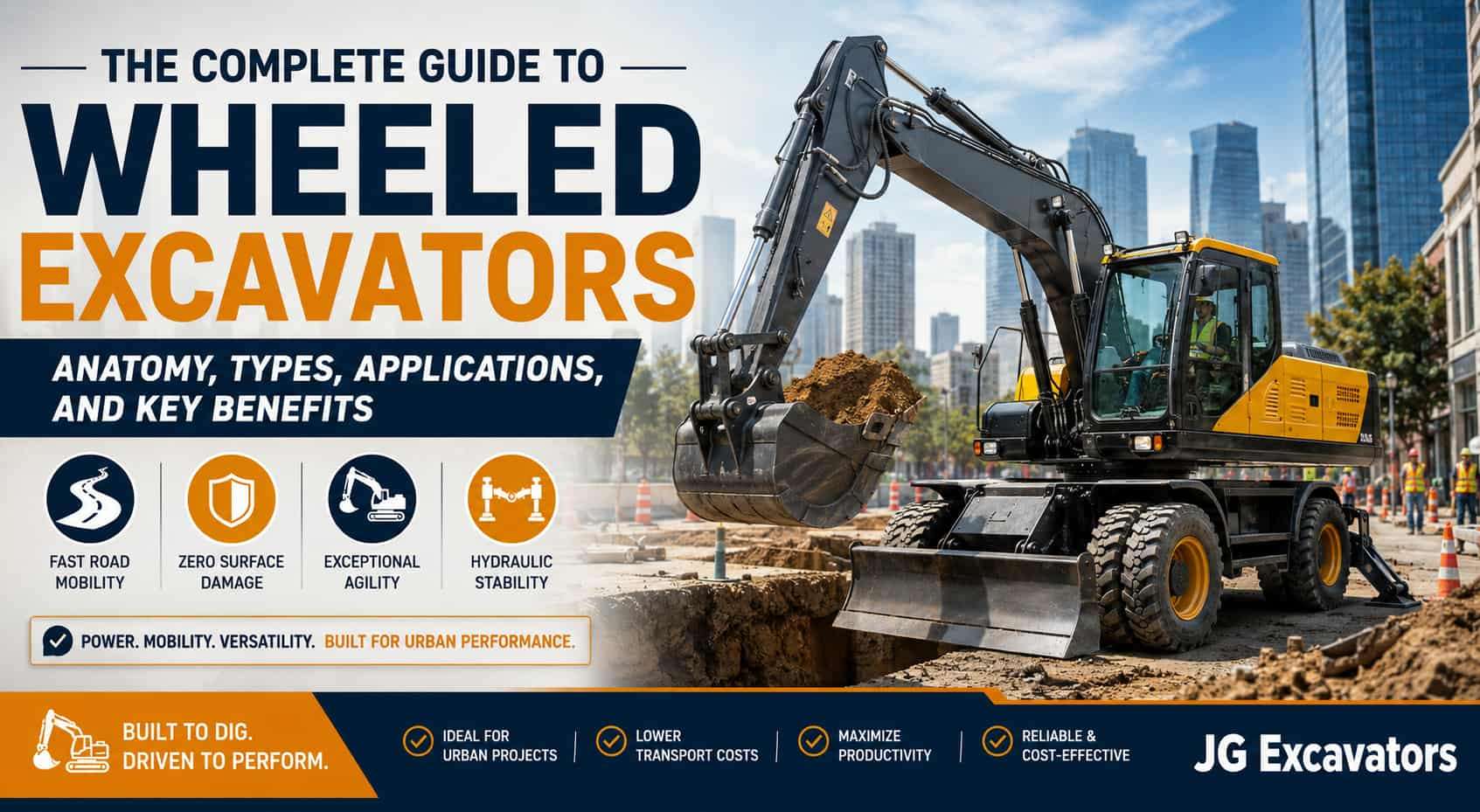
Wheeled excavators represent a critical evolution in heavy machinery design, combining the deep-digging power of traditional excavators with the rapid road mobility of rubber tires. Unlike track-mounted machines, a wheeled excavator can drive directly from one urban job site to another without needing a flatbed trailer. This rubber-tired mobility makes the wheeled excavator the primary choice for city construction, utility repairs, and road maintenance. The machine uses a heavy-duty chassis, a rotating upper structure, and a powerful hydraulic arm to dig, lift, and load materials. By utilizing hydraulic stabilizers and dozer blades, these machines achieve a rock-solid work foundation while preserving delicate asphalt surfaces.
Understanding the inner workings of a wheeled excavator is essential for any construction manager or fleet buyer. This guide explores the complete structural layout of these machines, their weight classes, and their steering systems. We will examine how different tires, stabilizers, and boom designs impact daily operations. Additionally, we will look at real-world applications in road construction, utility placement, and demolition. By analyzing the engineering balance between mobility and lifting capacity, you can make an informed decision for your next project.
A wheeled excavator is a self-propelled heavy construction machine designed for digging, lifting, and material handling. Unlike conventional crawler excavators that move on steel or rubber tracks, this machine operates on a heavy-duty, rubber-tired chassis. The core working concept relies on a high-torque diesel engine that powers variable displacement hydraulic pumps. These pumps send high-pressure hydraulic fluid through a central swivel joint to the drive motors, steering cylinders, stabilizers, and the front digging work group.
The upper structure of the machine can rotate a full 360 degrees. This allows the operator to dig in one direction and dump material in another without moving the lower chassis. The hydraulic system manages both movement and tool operations. When digging, the operator engages hydraulic stabilizer legs or a front dozer blade to lift the tires slightly off the ground. This action locks the chassis in place, turning a mobile vehicle into a rigid, highly stable digging platform.
Municipal projects demand machinery that can work efficiently in crowded, delicate urban environments. In these settings, rubber-tired mobility is a major operational advantage. Tracked machines scratch, crack, and tear up asphalt, finished concrete, and brick sidewalks. A wheeled excavator, however, moves on rubber tires that distribute weight evenly, preventing surface scuffing and structural pavement damage.
Additionally, municipal utility repairs often require working across several blocks in a single day. A wheeled machine can travel at speeds up to 30 km/h (18 mph) on public roads. This speed allows the operator to drive directly to water line leaks or cable trenching sites without waiting for a transport truck. By eliminating the need for heavy-duty trailers and loading permits, municipal utility crews can respond to emergencies faster and reduce traffic disruption in busy commercial districts.
Quick Sourcing Tip: Sourcing heavy machinery internationally can significantly lower your capital expenditure without compromising on durability. Connecting with verified suppliers of high-quality China wheeled excavator models allows you to secure robust, emission-compliant fleets with advanced hydraulic systems directly from the factory floor.
The engineering of a wheeled excavator is divided into three major structural assemblies that work in perfect harmony. These are the lower traveling undercarriage, the upper rotating platform, and the front digging attachment. High-pressure hydraulic oil connects these sections, allowing the machine to travel smoothly and execute high-force digging operations. By understanding how these three systems interact, fleet owners can maximize the service life of their equipment.
The undercarriage serves as the foundation of the wheeled excavator, housing the components that drive, steer, and stabilize the machine. This rigid steel frame must support the weight of the upper structure while absorbing the heavy forces generated during digging. The undercarriage contains the wheels, axles, stabilizers, and mechanical drive systems that allow the machine to travel safely on public roads.

The tires of a wheeled excavator support the entire weight of the machine and absorb the shocks of rough ground. Operators can choose between single tires or dual pneumatic tires.
Single tires are wide and provide a large contact area. This design works well in sandy or muddy yards where flotation is necessary to prevent sinking.
Dual pneumatic tires are the standard choice for general construction. They consist of two tires mounted closely together on each side of the axle. This configuration offers excellent stability during heavy lifting operations. To prevent small rocks and debris from getting wedged between the dual tires, manufacturers install rubber spacer rings. These spacers keep the gap clear, protecting the tire sidewalls from puncture damage.
The axles of a wheeled excavator must handle both steering and structural loads. The rear axle is typically bolted directly to the chassis frame, making it rigid. The front axle is an oscillating axle, meaning it can pivot up and down by several degrees. This oscillation ensures that all four wheels stay in contact with the ground when driving over uneven terrain, rocks, or curbs.
When the machine stops to perform a lift, hydraulic oscillation lock cylinders engage. These cylinders freeze the front axle movement, turning the oscillating axle into a rigid beam. This temporary locking action prevents the chassis from swaying while the operator swings heavy loads.
Hydraulic outriggers are heavy steel legs mounted to the front, rear, or both ends of the undercarriage. When deployed, double-acting hydraulic cylinders push these legs down to the ground. Broad steel pads at the end of each leg distribute the machine's weight over a wide area.
These outriggers lift the rubber tires slightly off the ground, taking the load off the suspension. This provides a wide, stable base that prevents tipping. Outriggers are essential when digging at maximum reach or lifting heavy concrete pipes over the side of the chassis.
The front dozer blade serves a double purpose. Primarily, it acts as a stabilizing device. When lowered to the ground, the blade anchors the front of the machine, preventing forward and backward rocking during digging.
Secondarily, the blade is a highly effective tool for backfilling trenches, leveling piles of dirt, and cleaning up debris on the job site. The blade is controlled by two heavy-duty hydraulic cylinders mounted under the chassis, which protects them from falling dirt and rocks.
The drivetrain transfers power from the upper hydraulic systems down to the wheels. It begins with a high-torque hydraulic travel motor mounted on the undercarriage. This motor connects to a powershift transmission. The powershift transmission allows the operator to change gears under load, shifting easily from high-speed road travel to low-speed, high-torque work modes.
From the transmission, heavy-duty drive shafts run to both the front and rear axles. These shafts use universal joints to handle axle movement during steering and oscillation, ensuring constant four-wheel-drive power.
Safety on public roads and steep slopes requires a highly reliable braking system. Wheeled excavators use a wet disc brake system integrated directly inside the wheel hubs. The brake discs run in an oil bath, which constantly cools the friction materials. This oil-cooled design prevents brake fade during long drives or heavy use. Wet disc brakes are fully sealed against water, mud, and abrasive construction dust, which reduces wear and extends the service life of the brakes.
The upper structure sits on top of the undercarriage and rotates a full 360 degrees. It acts as the command center and power source of the wheeled excavator. This section houses the diesel engine, hydraulic pumps, operator's cabin, and counterweight. The design of the upper structure focuses on operator comfort, safety, and efficient weight distribution to ensure maximum lifting capacity.
The engine is the heart of the wheeled excavator, powering all mechanical and hydraulic movements. Modern machines use clean-burning diesel engines that comply with strict global emission standards, such as EPA Tier 4 Final or EU Stage V. These engines use advanced fuel systems like common-rail direct injection to maximize fuel efficiency. To lower harmful emissions, they feature exhaust treatment systems like Diesel Particulate Filters (DPF) and Selective Catalytic Reduction (SCR) with diesel exhaust fluid (DEF).
Directly coupled to the diesel engine are variable displacement axial piston pumps. These pumps do not deliver a fixed flow of fluid. Instead, they adjust their output based on the load. When the operator meets high resistance while digging, the pump automatic control reduces fluid flow and increases system pressure. This maximizes breakout force without stalling the engine. When the arm moves freely in the air, the pump increases flow and lowers pressure, allowing for fast cycle times.
The cabin is designed to keep the operator safe, comfortable, and productive. It features a Roll-Over Protective Structure (ROPS) and a Falling-Object Protective Structure (FOPS) to guard against accidents.
Inside, the cabin contains dual controls. For excavation, the operator uses low-effort hydraulic joysticks. For road travel, the cabin includes a standard steering wheel, accelerator pedal, and brake pedal. Large glass panels provide a clear view of the surrounding work area, and soundproof insulation keeps engine noise out of the workspace.
At the very rear of the upper structure is a heavy cast-iron counterweight. This mass balances the weight of the boom, arm, and loaded bucket at the front. By keeping the center of gravity near the middle of the machine, the counterweight prevents tipping during high-reach lifts. Some compact models use a short-tail swing design, where the counterweight stays within the width of the chassis as it rotates, making it safer to work next to walls or highway traffic.
To rotate 360 degrees, the upper structure sits on a large ball-bearing slewing ring bolted to the chassis. A hydraulic swing motor drives a pinion gear that meshes with the internal teeth of this slewing ring. The swing motor has a high-torque output, allowing the machine to swing heavy loads smoothly even when working on slight slopes. A hydraulic swing brake automatically locks the upper cabin in place when the operator releases the controls, preventing accidental rotation.
The upper structure houses large, heavy-gauge steel tanks for diesel fuel and hydraulic fluid. The hydraulic tank features internal baffles to prevent the fluid from sloshing. It also includes cooling lines and high-capacity return filters to keep the oil clean. Keeping the hydraulic fluid cool and clean is essential to prevent wear on the delicate valves and pumps in the system.
The front working attachment, often called the work group, is the business end of the wheeled excavator. It consists of the boom, the arm, the hydraulic cylinders, and the bucket or attachment. This system translates the hydraulic pressure generated in the upper structure into physical digging force, allowing the operator to reach, dig, lift, and place materials with extreme precision.
The boom is the first large section of the digging arm. Buyers can choose between a standard Mono Boom and a Two-Piece (Variable Angle) Boom.
A Mono Boom is made of a single curved steel box section. It is strong, simple, and ideal for deep digging and heavy lifting in open spaces.
A Two-Piece Boom has an extra pivot joint in the middle, controlled by an adjustment cylinder. This extra joint allows the operator to stretch the arm straight out for maximum reach, or draw it in close to the machine's body. This makes the Two-Piece Boom perfect for working in narrow city streets, as the operator can dig deep trenches right next to the wheels of the machine.
The arm, also known as the stick or dipper, connects the boom to the bucket. It acts as the secondary lever in the digging group. The length of the arm directly determines the machine's maximum digging depth and reach. A shorter arm provides higher digging and breakout forces, which is useful for tough, compacted soils. A longer arm provides a wider working range, which is ideal for grading slopes and reaching deep utility lines.
High-pressure steel hydraulic lines run along the top and sides of the boom and arm. These carry fluid to the heavy-duty hydraulic cylinders. Each cylinder contains a hardened, chrome-plated steel rod that extends and retracts to move the arm joints. Manufacturers install protective metal guards over the bucket cylinder to shield the rod from falling rocks, asphalt chunks, and debris during deep digging operations.
To increase job site efficiency, most wheeled excavators are equipped with a hydraulic quick coupler at the end of the arm. This system allows the operator to change attachments in seconds without leaving the cab. Auxiliary hydraulic lines run down the arm to power these attachments. These lines provide high-flow, high-pressure fluid to tools like hydraulic breakers, compacting plates, and rotating scrap shears.
The final tool on the arm can be swapped to match the specific job requirements.
Wheeled excavators are manufactured in a wide range of designs to meet different job site conditions. Contractors can select machines based on their operating weight, the complexity of their steering systems, and how they stabilize themselves. Understanding these distinct classifications is the best way to choose a machine that delivers the right balance of speed, agility, and lifting power.
The operating weight of a wheeled excavator determines its physical footprint, digging depth, and lifting capacity. Choosing the correct tonnage ensures that the machine has enough hydraulic breakout force to handle the soil conditions of your job site. Manufacturers divide these machines into three major weight categories to serve distinct construction needs.
Compact or mini wheeled excavators weigh less than 10 metric tons. These small machines are highly agile and perfect for tight municipal environments, residential landscaping, and small utility repairs. They are light enough to drive over delicate asphalt without leaving marks, and their small engines consume very little fuel. They easily maneuver around parked cars, trees, and narrow alleyways.
B2B Procurement Note: To prevent expensive downtime and logistical delays, choosing a trusted mini excavator exporter is critical. A reliable export partner guarantees full CE/ISO documentation, transparent customs clearance, and long-term aftermarket parts support for your fleet.
Medium-sized models, weighing between 10 and 20 tons, are the most popular machines in the construction industry. They offer a perfect balance of power and mobility. These machines have the hydraulic strength to lift heavy concrete pipes, dig deep sewer trenches, and run large hydraulic attachments. At the same time, they are compact enough to drive safely on public roads without requiring special travel permits.
Heavy-duty wheeled excavators weigh over 20 tons and are built for high-production environments. They are common in large road building projects, scrap metal yards, and major utility installations. These heavy machines feature high-power engines, massive counterweights, and wide dual tires. They can lift large loads and dig deep into compacted soil, providing the high output of a tracked excavator with the mobility of a wheeled chassis.
The steering design of a wheeled excavator directly affects its safety on the road and its maneuverability on tight jobsites. Advanced hydraulic steering systems allow the operator to change modes with the press of a button inside the cabin. These steering configurations help the machine navigate around obstacles and work in crowded municipal zones without blocking traffic.
In standard road travel mode, the machine uses two-wheel steering. Only the front wheels turn, while the rear wheels remain fixed. This setup provides predictable, stable steering at high road speeds up to 30 km/h, preventing the machine from swaying or losing control on public roads.
When working on tight job sites, the operator can switch to four-wheel steering. In this mode, the front and rear wheels turn in opposite directions. This cuts the machine's turning radius nearly in half. It allows the operator to turn around in narrow city streets and position the machine next to trenches without blocking extra traffic lanes.
Crab steering turns all four wheels in the exact same direction. This allows the wheeled excavator to move diagonally or sideways without rotating the chassis. Crab steering is highly useful when parking the machine close to a wall, navigating around tight obstacles, or aligning the tires along a trench edge.
Because rubber tires can flex under load, stabilizing systems are used to anchor the machine during digging operations. The choice of stabilizers affects both the weight and lifting capacity of the excavator. Contractors can configure their machines with blades, outriggers, or a combination of both to achieve the perfect balance of mobility and static stability.
This configuration features a hydraulic dozer blade on one end of the chassis, while the other end has no extra stabilizers. This design is common on compact and light-medium machines. It keeps the machine light and easy to maneuver, while the blade provides enough support for light digging and backfilling tasks.
In this setup, the machine features two or four hydraulic outrigger legs but lacks a dozer blade. This configuration is designed for heavy lifting tasks on uneven ground. The independent hydraulic outriggers can be adjusted to level the chassis on sloped terrain, providing a stable platform for high-reach lifting and loading.
This is the most versatile and robust stabilization configuration. Typically, the machine features a dozer blade on the front axle and two outriggers on the rear axle. This combined system gives the operator the best of both worlds: the blade is used for quick stabilization and backfilling, while the rear outriggers provide a wide, rock-solid base for heavy digging and side-loading operations.
The unique combination of road travel speeds and heavy-duty digging power makes the wheeled excavator incredibly versatile. These machines are not confined to a single type of construction. Instead, they serve multiple industries, from municipal civil works and highway maintenance to scrap yard materials handling and structural demolition.
Urban utility networks are the lifeblood of modern cities, and maintaining them requires fast, precise excavation tools. Wheeled excavators excel in this field because they can travel directly on pavement and work within single-lane closures. Their ability to dig, lift, and restore surfaces makes them indispensable for municipal utility crews.
Wheeled excavators are highly effective for underground utility installations. When laying water, gas, or sewer pipes under city roads, the machine can dig a clean, straight trench, lift and position heavy concrete or steel pipes, and backfill the excavation using the front dozer blade. The rubber tires allow the machine to drive along the street as the trench progresses, minimizing traffic delays.
Installing modern fiber optic lines and power cables requires digging long, narrow trenches in crowded urban areas. Using a narrow trenching bucket, a medium wheeled excavator can cut precise paths through dirt and old asphalt. Since these utility lines often run under sidewalks and next to buildings, the compact footprint and high agility of a wheeled machine make it much easier to work without damaging existing infrastructure.
For light commercial and residential buildings, wheeled excavators are used to dig footings and foundations. The machine can drive directly onto the construction site, dig the foundation trenches, and help lift and place reinforcing steel bar cages. Because the machine does not damage public roads, it can move between multiple home construction sites in a single day, increasing productivity for contractors.
After utilities are laid, the trench must be filled and leveled. The wheeled excavator uses its front dozer blade to push excavated dirt back into the trench. The rubber tires can then drive over the filled area to help compact the soil. In public parks and urban landscapes, these machines are also used to plant large trees, place decorative rocks, and grade topsoil for lawns.
Highway maintenance crews must work quickly to minimize traffic congestion and ensure driver safety. A wheeled excavator can drive directly to road work zones at highway speeds, perform its tasks from the paved shoulder, and leave the site without needing a flatbed trailer. This rapid response capability makes highway repairs far more efficient.
Over time, highway ditches fill with silt, weeds, and debris, which blocks proper water drainage. Equipped with a wide, tilting grading bucket, a wheeled excavator can drive along the road shoulder and clean out ditches. The operator can reach down from the paved surface, scoop out debris, and load it directly into a dump truck, keeping the highway shoulder clear.
When repairing damaged sections of city streets, a wheeled excavator serves as a multi-tool. First, it uses a hydraulic breaker attachment to smash the old, cracked asphalt. Next, the operator switches to a bucket to clean out the broken debris. Finally, the machine helps level the aggregate base layer before new asphalt is poured, providing a fast, self-contained road repair solution.
By mounting a hydraulic auger tool to the arm, a wheeled excavator becomes an efficient drilling rig for highway guardrail posts. The machine can drive along the highway shoulder, drilling holes at precise intervals. It can then lift and position the steel guardrail posts into the holes, speeding up safety installations along busy roadways.
When storm debris, fallen trees, or accident wreckage blocks highway lanes, emergency crews need to clear the road quickly. A wheeled excavator can drive directly to the scene at highway speeds. Using a sorting grapple attachment, it can pick up large trees, crushed vehicles, and scattered cargo, loading them into trucks to reopen traffic lanes fast.
Industrial and shipping yards require constant material movement over flat, paved surfaces. Tracked machines are slow and wear out their tracks quickly on hard concrete. Wheeled excavators, however, can travel rapidly across large yards to sort scrap, stack timber, or load delivery trucks, making them ideal material handlers.
In recycling yards, material handlers need to sort through piles of sheet metal, engine blocks, and wire. A heavy-duty wheeled excavator equipped with a rotating grapple or an electromagnet attachment can sort through scrap piles and load them into shredders. The wheeled chassis allows the operator to drive quickly between different material piles across large, paved yards.
Forestry and lumber mills handle heavy, awkward logs that must be sorted by size and species. Equipped with a high-capacity log grapple, a wheeled excavator can sort timber, stack logs into high piles, and load log-transport trucks. The dual tire configuration provides the lateral stability needed to swing long, heavy logs safely.
In sand, gravel, and stone supply depots, wheeled excavators are used to load delivery trucks. The high cab position gives the operator an excellent view into the truck bed, helping them distribute the load evenly. The high travel speed allows the excavator to move quickly between sand piles, gravel beds, and weighing scales, reducing truck wait times.
Demolition work is often performed in tight urban areas where space is limited and surfaces must be protected. Wheeled excavators are highly valued in this sector because they can carry out light demolition, smash concrete, and load debris while operating on finished pavements without causing damage.
For interior renovations and light structural demolition, compact wheeled excavators are highly effective. They can drive through warehouse doors, demolish interior walls with a hydraulic hammer, and use a sorting grapple to carry debris out to dumpsters. The rubber tires prevent damage to concrete floors inside the building.
Demolishing old parking lots or roads requires breaking up thick layers of asphalt. A wheeled excavator equipped with a heavy hydraulic breaker can fracture the pavement quickly. The operator can then swap to a heavy-duty bucket to scoop up the broken asphalt and load it into haul trucks, leaving a clean sub-base behind.
When removing old concrete sidewalks or airport runway sections, the excavator uses its bucket teeth or a specialized slab-lifter attachment to pry up large concrete panels. The machine then lifts the heavy slabs and places them into haul trucks. The high lifting capacity and precise controls of a wheeled excavator make this heavy work safer and more efficient.
The choice to add a wheeled excavator to your construction fleet brings several immediate operational advantages. From logistic simplicity and road protection to extreme maneuvering capability, these rubber-tired machines solve many of the daily headaches faced by utility contractors and municipal road crews.
The ability to drive directly to a job site is the single biggest advantage of a wheeled excavator over a tracked machine. This rapid mobility changes how contractors plan their daily logistics, allowing them to complete more tasks per week. This speed results in massive savings on machinery transport and support equipment.
The most significant benefit of a wheeled excavator is its fast road speed. Able to travel up to 30 km/h (18 mph), these machines can drive directly on public roads. This eliminates the need to load the excavator onto a flatbed trailer, secure it with heavy chains, and haul it with a semi-truck. By avoiding trailer transport, contractors save time and can start working almost immediately.
In municipal work, crews often need to address multiple small issues across a city in a single day. A wheeled excavator can finish a water valve repair in one neighborhood and drive straight to a trenching job in another. This high mobility keeps the machine working instead of sitting on a transport trailer, maximizing daily productivity.
Transporting heavy machinery is expensive, requiring specialized haul trucks, trailers, fuel, and experienced drivers. Furthermore, moving tracked machines on public roads often requires special wide-load permits and escort vehicles. A wheeled excavator eliminates these logistics costs, lowering the total cost of ownership and increasing profit margins for construction companies.
Traditional steel-tracked excavators can cause severe damage to municipal infrastructure, resulting in high repair bills. Wheeled excavators eliminate this risk by riding on soft, air-filled rubber tires. This allows contractors to operate on delicate finished surfaces with complete peace of mind.
Tracked machines use heavy steel shoes that crush and tear asphalt surfaces when they turn. Even rubber-tracked machines can leave black scuff marks and damage delicate pavements. A wheeled excavator moves on smooth, air-filled rubber tires. These tires roll smoothly over asphalt without scratching the surface, making them perfect for working on finished city streets.

Historical districts and modern urban centers often feature delicate brick paving or finished concrete sidewalks. Tracked machines cannot work in these areas without using expensive protective rubber mats. Wheeled excavators can drive and work directly on these delicate surfaces without cracking the bricks or marking the concrete, preserving the surrounding infrastructure.
When tracked machines damage public roads or sidewalks, local governments often charge contractors expensive road repair fees and penalties. By using a wheeled excavator, construction companies avoid these extra costs and maintain a good working relationship with municipal authorities.
Urban jobsites are notoriously cramped, often requiring machinery to work next to open traffic lanes, walls, or low trees. Wheeled excavators use advanced steering and boom designs to minimize their working footprint, allowing them to dig and lift in close quarters.
The two-piece (Variable Angle) boom design allows the machine to work in very tight spaces. By folding the middle joint, the operator can draw the bucket in close to the front tires. This allows the machine to dig deep trenches in narrow alleys or under low overhead tree branches where a standard mono-boom machine would get stuck.
With four-wheel steering and crab steering, a wheeled excavator can navigate tight construction sites with ease. It can steer around tight corners, park close to walls, and align itself with trenches without requiring a large turning area. This maneuverability reduces the job site footprint, keeping more traffic lanes open during road work.
Working in busy city streets requires excellent visibility to prevent accidents with pedestrians, cars, and other workers. Wheeled excavators feature large, glass-paneled cabs, wide-angle mirrors, and rear-view cameras. They also include bright LED work lights, warning beacons, and travel alarms to keep everyone on the job site safe.
Skeptics often worry that a wheeled machine will shake or tip during heavy digs. However, modern hydraulic stabilizers provide a level of stability that rivals any tracked machine. These systems turn a highly mobile vehicle into a rigid, safe work platform at the flip of a switch.
While rubber tires are excellent for travel, they can bounce and sway during heavy digging. To solve this, the machine uses hydraulic outriggers. When lowered, these legs lift the tires slightly and create a broad, solid base. This provides the stable lifting performance of a tracked machine, allowing the operator to lift heavy loads safely.
The front dozer blade works as both a stabilizer and a grading tool. When lowered, it keeps the front of the chassis stable during digging. On sloped ground, the operator can use the blade to push dirt and level a flat work pad, allowing the excavator to work safely on hillsides.
Lifting heavy objects over the side of the machine is a common cause of tipping accidents. The combination of rear outriggers and a front dozer blade provides excellent lateral stability. This allows the wheeled excavator to lift heavy concrete pipes or steel beams over the side of the chassis and load them into dump trucks with confidence.
The wheeled excavator is a highly versatile and cost-effective machine that combines high digging power with rapid road mobility. By utilizing a heavy-duty chassis, rubber tires, and advanced hydraulic stabilization systems, these machines can drive directly to job sites and perform heavy excavation work without damaging public roads. Their multi-steering modes and two-piece boom designs make them highly agile in narrow city streets, making them the primary choice for modern urban construction and utility projects.
When selecting a wheeled excavator, it is important to match the machine's weight class, steering modes, and stabilizer configurations to your specific project needs. Choosing the right tires, outriggers, and attachments will maximize efficiency and ensure a safe, productive operation. Investing in a high-quality wheeled excavator allows fleet owners to lower transport costs, respond to emergency repairs faster, and protect delicate city pavements.
Selecting the right machinery for your fleet is a major investment that directly impacts your project timelines and operating costs. When you need heavy-duty performance combined with advanced hydraulic engineering, partnering with an experienced machinery manufacturer is key. Working directly with a dedicated manufacturer ensures that your fleet receives the latest technology, robust steel structures, and highly efficient engines designed to meet strict emission standards.
For your next construction project, consider sourcing high-quality machinery from JG Excavators. As one of the leading wheeled excavator suppliers, we offer a complete line of durable, high-performance machines designed to handle tough municipal and road-building projects. Our team provides comprehensive aftermarket support, reliable spare parts delivery, and custom equipment configurations to keep your projects running smoothly. Contact us today to discuss your fleet requirements and secure a dependable, cost-effective machinery solution.
A crawler excavator depends entirely on its tracks for movement, st
READ FULLWheeled excavators represent a critical evolution in heavy machiner
READ FULLCrawler excavators stand as the most common heavy digging machines
READ FULL


