




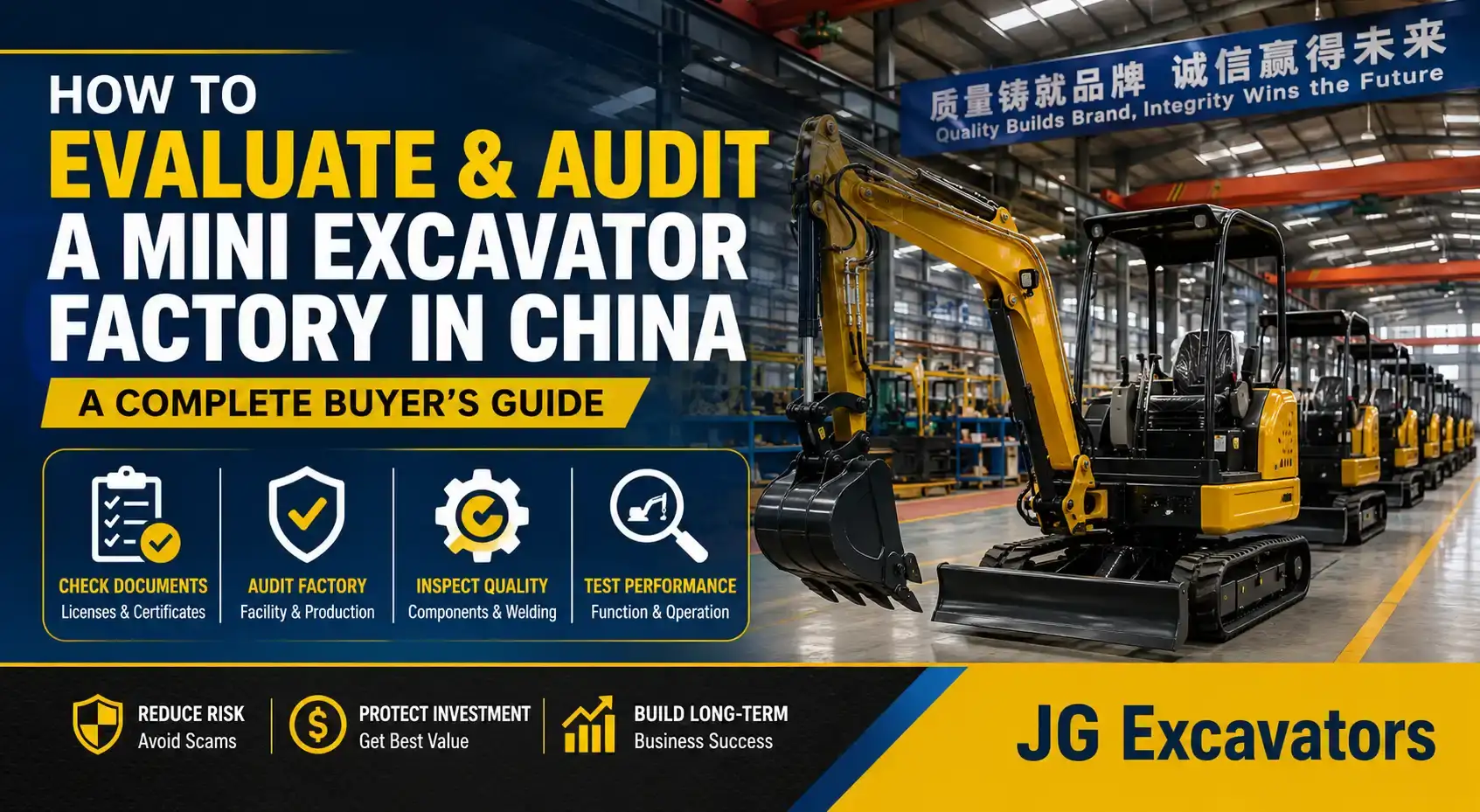
Buying construction machinery from another country is a big decision that involves a lot of money. If you want to import compact diggers for your rental business, dealership, or construction projects, you must find a trusted mini excavator exporter who can deliver high-quality machines without any hidden issues. Many international buyers fall into traps because they order directly from online listings without checking the actual setup of the supplier. A beautiful website or a polished sales pitch does not guarantee that the supplier owns a physical manufacturing facility or follows strict quality control standards.
To protect your investment and avoid common importing scams, you need to conduct a thorough evaluation and on-site audit of the Chinese factory. This complete guide provides a step-by-step roadmap to check the legal status, technical capabilities, welding quality, hydraulic components, and real-world testing procedures of a mini excavator manufacturer. By focusing specifically on the mechanical parts and operational steps of small diggers, you can easily separate real, high-quality factories from middleman trading companies before you send any deposit.
Before you book a flight to China or hire a local inspection agency, you must check the paperwork of the supplier. This initial step helps you filter out high-risk suppliers and middlemen who do not have the legal right to manufacture heavy machinery.
Every legitimate company in mainland China has an official business license issued by the local government. You must ask the supplier to send a clear, color scan of this document.
Once you receive the license, look closely at the "Business Scope" (经营范围) section. A genuine manufacturer will have words like "Production" (生产), "Manufacturing" (制造), or "Processing" (加工) of construction machinery or excavators. If the business scope only contains words like "Sales" (销售), "Retail" (零售), or "Wholesale" (批发), the supplier is a trading company. Middlemen do not own a factory, and they buy machines from other workshops, which increases your purchase cost and limits your control over product quality.
Mini excavators use diesel or gasoline engines to power their hydraulic pumps. Customs departments in major markets have strict environmental rules regarding engine emissions. If your imported machines do not have the correct emission certificates, customs officers will seize them at the port, and you will lose your money.
| Target Market | Required Emission Certificate | Approved Engine Examples |
|---|---|---|
| United States | EPA (Environmental Protection Agency) Certificate | Kubota D902, Yanmar 3TNV70 |
| European Union | Euro Stage V Certificate | Kubota D722, Koop KD192F |
| Australia | ADR (Australian Design Rules) compliance | Kubota, Yanmar, Perkins |
You must ask the factory to show you the official emission certificate issued by the engine manufacturer. Make sure the serial numbers and engine model numbers on the certificate match the actual engines installed in the mini excavators you want to buy.
A physical or virtual video audit of the workshop floor reveals the true assembly standards of the manufacturer. You should look beyond the clean floors and inspect the specific mechanical areas where mini excavators are built.
The chassis, boom (main arm), and bucket arm of a mini excavator experience extreme stress during digging operations. If the steel is too thin or the welding is weak, the metal will crack under pressure after a few months of heavy work.
Look for factories that use robotic laser welding machines instead of manual welding torches for the boom and arm. Robotic welding creates smooth, deep, and consistent weld lines that distribute stress evenly across the metal structure. You should also check the thickness of the steel plates on the undercarriage. High-quality mini excavators use Q355B structural steel, which provides high strength and prevents the frame from bending when the machine travels over rough stones or mud.
The engine is the heart of your small digger. Many low-priced mini excavators in China use cheap, single-cylinder Chinese air-cooled engines. While these are okay for light garden work, they are not suitable for professional construction or long working hours.
If you pay for a premium multi-cylinder water-cooled engine like a Kubota or Yanmar, you must verify its authenticity during the audit. Check the metal nameplate on the engine block. A genuine engine has a deeply engraved serial number, a clean brand logo, and professional paint finish. Look out for fake engine plates that are simply glued or riveted onto cheap, unbranded engines. You can ask the factory to show you the purchase invoices from the official Kubota or Yanmar distributors in China to prove they buy genuine engines.
Hydraulic systems control the digging force, smooth rotation, and travel speed of the machine. A mini excavator can have a great engine, but it will perform poorly if the hydraulic components are cheap.
During the workshop walk-through, look at the brand names of these three critical hydraulic parts:
[Hydraulic Pump] -------> [Control Valve] -------> [Travel & Swing Motors]
(Creates Oil Flow)        (Directs Oil Power)       (Drives Track & Cabin)
A good factory does not just assemble parts and put the machine in a container. They must test every single mini excavator under working conditions to identify leaks, assembly mistakes, and performance issues before shipping.
Hydraulic fluid operates under high pressure, which can exceed 18 Megapascals during tough digging tasks. The factory must have a dedicated test area where workers connect pressure gauges to the hydraulic lines.
The technician should run the engine at full speed and hold the control levers to keep the cylinders fully extended for several minutes. You must check the connections between the hydraulic hoses, steel pipes, cylinders, and the main valve. If there are low-quality rubber seals or loose fittings, you will see thin oil mists or drops forming at the joints. A proper factory will reject any machine that shows even a single drop of oil leakage during this pressure test.
Heavy work causes the hydraulic fluid and engine to heat up. If a mini excavator has a poorly designed cooling system, the hydraulic oil will overheat, which thin outs the oil and damages the internal seals of the pumps and motors.
Ask the factory how long they run the machines for continuous testing. A reliable manufacturer will run each unit for at least one to two hours in a test yard. During this time, they should use infrared thermometers to measure the temperature of the hydraulic oil tank. The oil temperature should stay below 65 degrees Celsius. If the temperature climbs too high, or if you hear loud, high-pitched whining noises from the hydraulic pump, it means the system has internal restriction or air bubbles.
A complete audit must include a practical driving and digging test. The tester should drive the mini excavator forward and backward over wooden blocks or dirt slopes to see if the rubber tracks stay aligned.
       [360-Degree Cabin Swing]  <--- Checks for gear play & smooth rotation
                |
     [Boom and Bucket Movement]  <--- Verifies digging depth & cylinder speed
                |
      [Straight-Line Driving]    <--- Confirms both tracks run at equal speed
The operator should also check the swing boom feature, which allows the arm to swing left or right without moving the cabin. This feature is very helpful for digging close to walls. If the joints are too loose, the bucket will wobble, which makes precise digging very difficult. The movements must feel smooth, responsive, and predictable.
The audit is not finished when the machine leaves the test yard. A factory's spare parts inventory and packaging discipline tell you how they will treat you after the sale.
A mini excavator is a working machine that requires regular maintenance. Over time, you will need replacement filters, hydraulic hoses, bucket teeth, and rubber seals.
A reliable manufacturer maintains an organized, dust-free warehouse stocked with these wear parts. During the audit, ask the warehouse manager to show you how they label and store spare parts. If the factory has a neat inventory system, they can ship replacement parts to your country quickly when you need them. If the warehouse is messy and unorganized, it tells you that their after-sales support will be slow and frustrating.
Sea voyages can take several weeks, and rough waves shake shipping containers throughout the journey. Ask the factory to walk you through how they typically secure machines inside a container before loading, since sloppy bracing at this stage leads directly to bent metal and scratched paint on arrival. A factory that treats this step seriously usually shows the same discipline throughout the rest of production.
Evaluating and auditing a mini excavator factory in China is the most effective way to protect your business investment and secure reliable machines. By breaking the process down into manageable steps, you can eliminate untrustworthy suppliers before making any payments. First, verify the company's legal status by checking the business license for manufacturing keywords, and confirm that their engines possess valid EPA or Euro Stage V certificates. Second, inspect the mechanical build quality on the workshop floor, focusing on robotic welding lines, genuine engine serial numbers, and reputable hydraulic pumps, valves, and motors.
Third, ensure that every assembled machine undergoes rigorous testing, including high-pressure hydraulic leak checks, oil temperature measurements, and actual digging tests in a dirt yard. Finally, check that the manufacturer maintains a well-organized spare parts inventory and follows disciplined loading practices before shipment. Following these precise evaluation steps will help you establish a secure, profitable, and long-term partnership with a high-quality Chinese manufacturer.
Finding a reliable partner in China is the key to expanding your fleet or machinery business with confidence. Working with an experienced manufacturer ensures that your equipment meets strict global standards and performs flawlessly on every job site.
If you are ready to source high-performance mini excavators built with genuine components, robotic welding, and rigorous quality control testing, we are here to support your business goals. Contact JG Excavators today to discuss your specific machine requirements, get a detailed quote, and learn how we help international buyers import top-tier construction equipment safely and efficiently.
A crawler excavator depends entirely on its tracks for movement, st
READ FULLWheeled excavators represent a critical evolution in heavy machiner
READ FULLCrawler excavators stand as the most common heavy digging machines
READ FULL